
Tajikistan’s international image: history, culture and diplomacy



The Silk Road
Tajikistan is a vibrant blend of Indo-European and Asian cultures, an Iranian people and the Persian language. Its foundations also include an Islamic heritage, ancient roots and national traditions. First and foremost, I would like to highlight the factors that shaped Tajikistan’s culture and ethnic identity, since history has the greatest influence on any country’s present and shapes its political system for many centuries.
So, the first topic under consideration is the Silk Road.
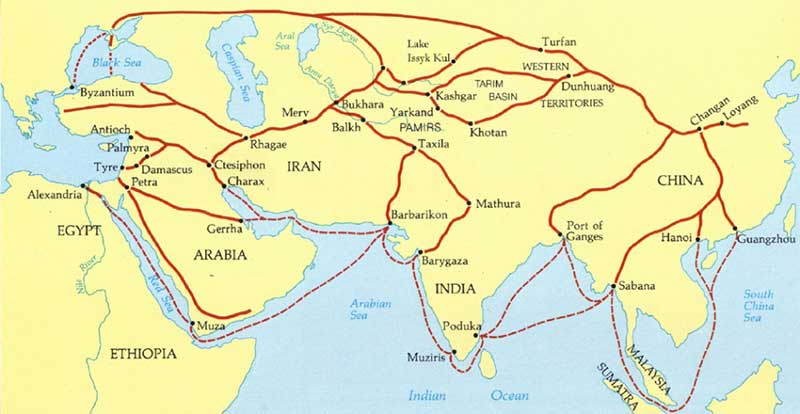
Available: https://www.pandasilk.com/uk/who-created-silk-road/
It was a network of trade routes linking China and the countries of Central Asia. The route passed through India, Central and North-East Asia, southern Siberia and the Urals. Its history stretches from the second half of the first millennium BC (the 5th–1st centuries BC) to the middle of the 20th century. Some routes survive today as railways and roads. These connections began to emerge a millennium earlier, driven by the extraction of semi-precious stones in what is now Iran. Lapis lazuli from the mountains of Badakhshan and jade from the Yarkand River area were transported to China along ancient nomadic routes. Jade was prized for its beauty and was believed to have magical and healing properties. It was used to make various insignia, jewellery, household items and amulets. Jade was popular in China, although the Chinese had no idea where it came from. This route became known as the Jade Road and for many centuries connected the principalities of northern and central China with Khotan. By the Warring States period, the Chinese were already travelling to the far west, although the journey was so difficult and dangerous that only 10 out of every 100 travellers returned safely. Another route in this vast network was the Meridian, or Western, Route, which linked southern Siberia, Central Asia and north-west China with south-west China, Vietnam and Burma. At times, entire nomadic peoples travelled along these roads, as did refugees fleeing the Arab conquests. This route brought new religions to China: Manichaeism, Zoroastrianism, Islam and Christianity. The northern section of the route became known as the Kyrgyz Route, and later the Steppe Route also emerged. Buddhism spread from India to China along these routes, as did bamboo canes and textiles. Zhang Qian explored these two routes, discovering them during the reign of Emperor Wu. His journeys had diplomatic aims: by the time of his visits, the political power of Central Asia had entered into diplomatic and trade relations with China, helping to boost trade and expand the reach of the trans-Eurasian trade artery. So, we have seen what the Silk Road brought to China, the main country involved in these trade relations. But what about the other side? Through this trade artery, Tajikistan received textiles and clothing from China, porcelain and ceramics, items made from precious metals, ivory and carved stone, as well as spices and medicinal herbs from the East. The technology of paper-making also spread throughout the world along caravan routes, including to Tajikistan. This important route also brought Buddhism, Manichaeism and Islam to Tajikistan, as well as various sciences such as astronomy and mathematics, and technologies for cultivating new crops.
To better understand the subject, I would draw a parallel with Ukraine’s Chumak Way, a trade route. It was a trade and transport route along which Chumaks carried salt from the Black Sea coast of Crimea from the 16th to the 19th century, while Ukraine exported grain and other agricultural products. It covered only Ukrainian territory (from the left bank of the Dnipro to Crimea), which was much smaller than the Silk Road, but played an equally important role in the import and export of goods for Ukraine. International trade relations continue to develop today, undergoing reforms and being shaped by new agreements between countries. In my view, however, the Silk Road was the first global trade route: it initiated transnational trade and helped it develop. Of course, trade had existed before, to some extent, but the Silk Road showed a significant part of Eurasia that commerce was not simply an exchange of goods, but international cooperation. In the future, this cooperation between countries could extend to the military sphere, providing support during armed attacks—something invaluable during invasions by nomadic tribes.
Long before and long after the Silk Road, there was no separate Tajikistan; there was only Persia, an association of the countries that would emerge in the future.
Persian rule
The Elamite people emerged in the third millennium BC. In the first half of the second millennium BC, virtually all of Mesopotamia was under Elamite control. Elam and Assyria were the two most powerful civilisations in the Middle East, and for centuries they fought for control of Mesopotamia. A fierce struggle took place in the 8th–7th centuries BC, in which Assyria emerged victorious. Elam declined, bringing the peoples of Iran—the Medes and Persians—to the fore. Media had always been a rather unstable alliance, but when the defeated Elam came under its influence, King Cyaxares also succeeded in bringing the Scythians to heel. During the reign of Cyaxares’ son Astyages (584–550 BC), friendly relations with Babylon broke down. While Median forces were fighting Babylon in the west, the southern part of Iran—Persia—rebelled against Astyages. The revolt was led by Cyrus II. Thus began the rule of the most powerful dynasty, the Achaemenids. From 3,550 BC, Cyrus II conquered the Median kingdom, thereby laying the foundations of the Persian Empire. The Achaemenid dynasty created the most powerful and largest state in the history of Persia. Its territorial centre was Iran, which retained the name Persia until the 20th century. The state lasted until the campaigns of conquest by Alexander the Great in the second half of the 4th century BC.
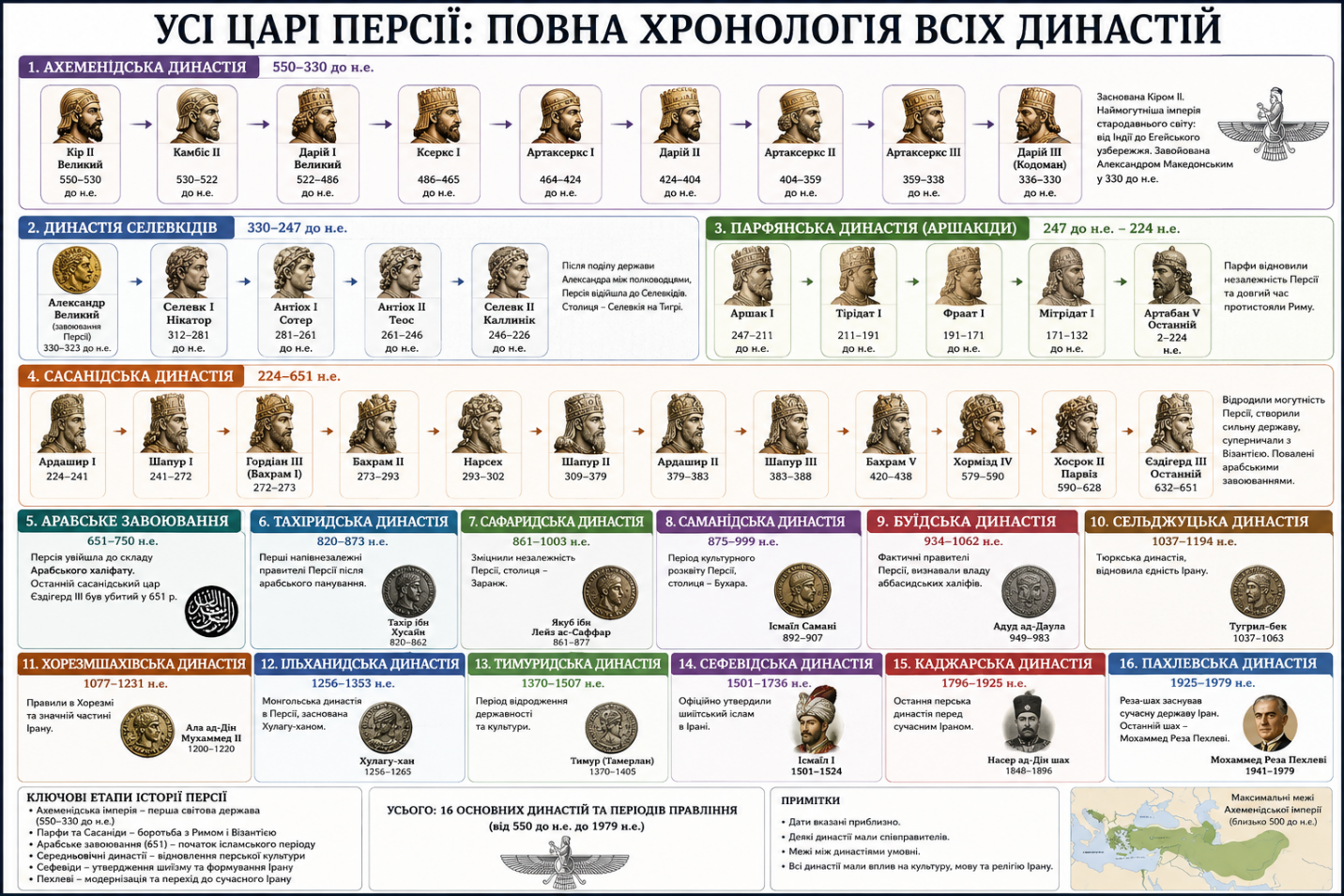
The Samanid dynasty had the greatest influence on both Tajikistan and Persia as a whole, uniting a considerable number of lands under its rule, from the Syr Darya to Iran. This period of unity was considered a golden age for Persia in trade and crafts, and for the expansion and development of its cities.
The Mongol invasion
Until 1220, the territory of modern-day Tajikistan was part of the Kara-Khanid Khanate, the Qara Khitai and the Khwarazmian Empire. The year 1220 left its mark on history as the Mongol invasion, which marked the beginning of the destruction and decline of Persia. In 1220, parts of Persia, including the territory of what was then Tajikistan, came under the rule of the Mongol Empire. The conquerors, led by Genghis Khan, demolished and burned entire cities along their route, turning arable land into pasture. Local people who managed to flee the cities settled in the mountains, while others were enslaved, deported to Mongolia or simply killed. The indigenous inhabitants continued to uphold a unique language, culture and national identity, but the population declined and came under oppression, so it is fair to say that the culture itself also suffered a decline. In 1222, the Mongol army marched towards the Caucasus Mountains and then on to Crimea, where it captured the fortress of Sudak. The princes of Kyiv, Halych, Volhynia, Chernihiv, Smolensk, Kursk, Trubchevsk and Putivl united to fight the Mongols. This alliance assembled an army of 50,000–60,000 on Khortytsia Island. When the Mongols learned of this, they sent envoys to the Rus princes, proposing that they abandon the campaign, since the Mongols were interested only in the Cumans. The princes rejected the proposal and, by killing the Mongol envoys, added fuel to the fire and caused the conflict to escalate further. In May 1223, the united army set out to fight the Mongols. The overconfident Rus princes let their guard down because the Mongol force seemed relatively small and was simply driving livestock ahead of it. However, the ensuing battle against a slightly larger force proved fatal. The battle took place on the Kalka River, where six Rus princes lost their lives. Then, in 1237, the Mongol army also surrounded the Principality of Ryazan in Kievan Rus. The conquest of Rus territory proceeded very quickly, and by 1240 the Mongols had surrounded Kyiv. After a lengthy siege, the capital was eventually taken by storm and suffered devastating destruction. The Mongol army then continued westwards without stopping, reaching the countries of Europe and the Balkans and destroying cities, burning villages and terrorising the population along the way. As a result, more than half of the cities were destroyed; some never recovered, while others became villages. This was a severe decline for Rus: it not only held back the development of crafts, urban settlements and the secrets of jewellery-making, but halted all progress. The area of cultivated land shrank, and some districts were depopulated. It took 100 years to restore construction to its pre-Mongol level.
Meanwhile, the territory of modern-day Tajikistan was in complete chaos: cities had been wiped off the face of the earth, and the irrigation systems that sustained the fertile land had been so badly damaged that the land became semi-desert. Nomadic Turkic and Mongol tribes began settling in large numbers on the devastated, scorched lands, causing ethnic divisions and intermingling. The conquerors also introduced the ‘qapchur’ system: taxes on livestock and levies to maintain Mongol garrisons. Culturally, the indigenous population who upheld Tajikistan’s ethnic values declined; the largest libraries were burned, and the spiritual elite and educators were killed, plunging the culture into darkness. However, the Mongols had little experience of governing large states, since they were themselves nomadic tribes, so their policies did not last long and instead began to favour Persia.
Thus, the main area affected by the Mongol invasion was the ethnic and linguistic landscape. Since most of the population had previously been Iranian-speaking, and the Mongols brought in Turkic tribes, Turkic culture and language began to spread across the territory of Tajikistan. Despite this, modern Tajikistan became the only Iranian-speaking country in Central Asia, surrounded by Turkic republics. The indigenous population was better preserved in the mountainous parts of Tajikistan, where the Mongols’ nomadic cavalry could not fight effectively. The term ‘subjugation of the conquerors’ is entirely appropriate: the Mongols were nomadic tribes without the necessary experience of governing states, and they themselves began to adopt the Tajiks’ language and culture, later converting to Islam.
A kind of Renaissance began in 1238–1239. Very quickly, the indigenous population, particularly the clergy, began to occupy leading administrative positions. In this way, the conquerors began to assimilate into the local population, adopting its culture and language and converting to Islam. A key event was the appointment of the Tajik statesman Masud Beg as governor of Transoxiana. His appointment served as a catalyst for reforms that paved the way for the future of Tajikistan. The most influential reforms were:
Monetary reform — this marked the beginning of economic recovery and financial stability. The issue of a single full-weight silver coin literally revived trade along the Silk Road.
Reconstruction of cities — major rebuilding in the cities of Bukhara, Samarkand and Khujand, as well as the return of people to those cities.
Tax stabilisation — the Mongols’ opaque system of taxes on livestock was replaced with fixed taxes, making it possible to continue restoring irrigation systems and canals.
The final restoration and ‘Golden Age’ of Tajik architecture, culture and all aspects of life came under the rule of Amir Timur (Tamerlane), who made Samarkand his capital. The exact length of his reign has not been established, but it is generally dated to 1370–1405. Tamerlane’s descendants ruled until 1500. Their rule was also a period of flourishing, particularly in culture, the arts and science. It was under their rule that Persian gained the status of an official language and became the language of administration, poetry and science.
An intervening period of cruelty and conquest. The Soviet period.
The period from 1500 to 1860 was the most difficult in Tajikistan’s history. It was a time of severe decline, which began with the invasion of Transoxiana by Uzbek nomadic tribes. Under the leadership of Muhammad Shaybani Khan, they conquered Samarkand, Herat and Bukhara, bringing the rule of the Timurids to an end. Although military and political power passed entirely into the hands of the conquerors, the Tajiks, who were settled townspeople and farmers, did not come under their influence. The indigenous Tajiks retained control of crafts, religious offices and trade. Tajik (Persian) also remained the official language. The state established by the conquerors became known as the Khanate of Bukhara. In general, Central Asia was divided into three rival khanates: Bukhara, Kokand and Khiva. The Khanate of Bukhara controlled the central and south-western parts of modern-day Tajikistan; the Khanate of Kokand controlled northern Tajikistan; and the Khanate of Khiva had no direct authority over the territory, but its constant raids destabilised the region as a whole. There were many reasons for this division:
The development of sea routes to India and China made the Silk Road, once the main trade route, unnecessary and dangerous. It is logical that an overland route takes more time and requires more money to support the people transporting the goods. The Silk Road was also more dangerous than the sea route, as disputes between countries had intensified during this period, and nomads could attack anywhere along the way, meaning there was no guarantee that goods would reach their destination at all. The Silk Road’s loss of importance led to the loss of enormous revenues from customs duties and international trade, which in turn made it impossible to maintain a strong centralised army. It also dispersed power and weakened the necessary control over the provinces.
Power became increasingly fragmented. As I mentioned earlier, the nomads lacked experience in governing large states, and sometimes even smaller ones. Thus, even when the Uzbek khan sat in Bukhara, real power belonged to the leaders of the major tribes. After the decline of the Silk Road, land and water became the only sources of wealth. The tribal nobility rebelled against the khans and refused to pay taxes, while also taking power in their own regions. This led to the emergence of many new dynasties and states. This chaos was largely caused by the absence of the centralised authority needed to keep such developments under control.
At the beginning of the sixteenth century, the Safavid dynasty established itself in Iran and adopted Shia Islam. The problem was that Sunni Islam remained the principal religion in the other khanates of Central Asia. This isolated Central Asia from cultural and economic ties with Persia. These differences continually exacerbated the conflict between Iran and Central Asia. The Iranian ruler Nader Shah dealt a fatal blow to Central Asia by sacking Bukhara and Khiva, finishing off the already weak central authority in these regions.
One area of particular interest was Eastern Bukhara. This is an inaccessible, mountainous region in what is now Tajikistan. Because central authority was weak, the region effectively became independent. As noted above, power belonged to the leaders of the major tribes. Eastern Bukhara was divided into small autonomous territories known as bekdoms. There were seven in total, each headed by a local ruler—a mir or bek—who was often an indigenous Tajik. Despite their small size and formal independence, the bekdoms were constantly at war with one another, looting caravans and raiding each other.
It was during this period of fragmentation, uncertainty and chaos that a new chapter in Tajikistan’s history began: its conquest by the Russian Empire. This period, dated 1860–1917, divided the lands of what was then Tajikistan in two. The northern Khujand district was fully annexed by Russia and incorporated into the Governor-Generalship of Turkestan. The centre and south (Eastern Bukhara), as well as the Western Pamir (the mountainous part of Tajikistan), were under the authority of the Emirate of Bukhara, a vassal of Russia. Tajikistan began to develop economically and industrially, but this development brought more harm than good to the population. The authorities levied excessive taxes, demanding more than the population could afford to pay. This exhausted the people and fuelled social discontent. This oppression led to the major Central Asian uprising of 1916, also known as the People’s Liberation Uprising (Urkun). In addition to the obvious general causes of social, capitalist and tax oppression, there were also specific triggers. These included the signing by the Russian Emperor Nicholas II of a decree ordering the ‘mobilisation’ of men from the indigenous population of Central Asia aged 19–43 for labour behind the lines (digging trenches and building defensive structures on the European fronts). Previously, the indigenous Muslim population had been exempt from military service, so the decree angered the people. The order also came at the height of the agricultural season, and the lack of sufficient numbers of people to bring in the harvest threatened famine. But, as we know, the Russian authorities were well versed in terrorism and threats, so all the uprisings were brutally suppressed; entire demonstrations were shot, and settlements belonging to people who refused to hand over men for mobilisation were burned down. Crops were also destroyed and livestock confiscated, condemning thousands of families to famine. In general, any disobedience was punishable by execution on the spot, while towns were placed entirely under the control of troops tasked with maintaining order.
After numerous revolutions, central authority disappeared completely, and the region broke up into isolated zones. Northern Tajikistan was controlled by the Bolshevik Turkestan Republic (based in Tashkent), while the central and southern parts were governed by the representatives of the Emir of Bukhara. As predicted, widespread famine gripped the region, claiming an unimaginable number of lives. The territory of what was then Tajikistan was also completely cut off from the outside world, with no way to escape the famine: the railway connections had been destroyed and trade had stopped. Chaos also reigned in the streets: local criminal bosses and former officials of the emir joined together in their own armed groups and looted peasants, while fighting one another over pastures and water sources.
Thus, this period can rightly be called one of the most difficult in Tajikistan’s history: constant terror, executions for disobedience, the destruction or deportation of entire towns, the assaulting of districts with aircraft and artillery, the burning of settlements, and the confiscation of property, grain and livestock. Many people fled across the Panj River to Afghanistan to escape, and most of them never returned. This period continued until 1926.
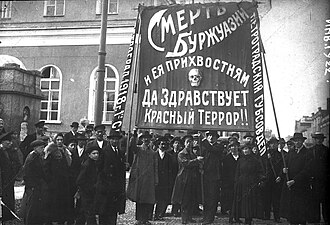
Posters at a protest by civilians against the bourgeoisie. Available at: https://uk.wikipedia.org/wiki/%D0%A7%D0%B5%D1%80%D0%B2%D0%BE%D0%BD%D0%B8%D0%B9_%D1%82%D0%B5%D1%80%D0%BE%D1%80
From 1924 to 1929, Tajikistan existed as an autonomous republic within the Uzbek SSR. Tajikistan’s incorporation was advantageous to the USSR, as it extended the communist regime into the East. The granting of separate republic status was also intended to appease the local population and finally eliminate the anti-Soviet insurgent movement (Basmachism), which was concentrated in the mountains. In October 1929, Tajikistan officially left the Uzbek SSR and became a full-fledged Tajik Soviet Socialist Republic. This decision was legally formalised at the Second Extraordinary Congress of Soviets of Tajikistan. In 1929, the main tragedy and injustice was the redrawing of the borders. The authorities transferred the territory of the Khujand district to the newly established Tajik SSR, enabling the republic to reach the population threshold required to join the union. As a result, the historical and cultural centres of the Tajik people remained in Uzbekistan.
From the 1930s to the 1980s, Soviet industrialisation spread across Eurasia. Tajikistan was a rather underdeveloped region that needed a clear development plan and new policies. Industrialisation provided precisely this impetus for development. It created the model for modern Tajikistan, but made its economy dependent on Moscow.
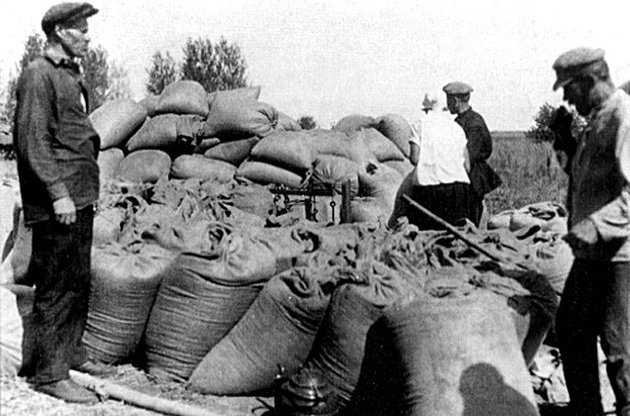
Economic changes included, for example, the construction of new enterprises in light industry, mining and food production; the extraction of coal, oil and rare metals; the development of hydroelectric power and research into renewable energy sources. Negative consequences included political repression, familiar from across the Soviet Union, directed against the entire population, particularly the elite and cultural and religious figures. The policy of forced collectivisation, which was also characteristic of Ukraine at the time, destroyed traditional agriculture and led to famine.
The photograph shows Soviet forced collectivisation in Tajikistan during the 1930s–1980s. Available at: https://zn.ua/ukr/HISTORY/ukrayina-u-vogni-selyanski-protesti-proti-kolektivizaciyi-_.html
Modern Tajikistan and its culture
Next, we will look at Tajikistan closer to the present day, focusing on its culture and its influence on international politics and its image.
As in any country, culture shapes a country’s positive image on the international stage. It also lays the foundations for governance and the legal system. Cooperation with UNESCO, participation in international cultural events and the promotion of national identity abroad play a significant role in political self-presentation. Tajikistan places great value on its traditions, and many of them have therefore been included on UNESCO’s Representative List of the Intangible Cultural Heritage of Humanity.
These include:
- The musical art of Shashmaqom
- The name translates literally as ‘six maqoms’, brought together in a single cycle. A maqom is one of the fundamental concepts in the professional music of Uzbeks and Tajiks; it can be understood as a modal-melodic model or as a musical genre. It is related to the Arabic maqam (a melodic model) and the Azerbaijani mugham (a musical genre). Shashmaqom took shape in Bukhara in the 18th century. It comprises the maqoms ‘Buzruk’ (‘Buzurg’), ‘Rost’, ‘Navo’, ‘Dugoh’, ‘Segoh’ and ‘Iroq’, each of which has two main sections: the instrumental mushkilot and the vocal nasr. The instrumental section consists of the parts tasnif, tarjī, gardun, mukhammas and saqil, although their melodic material differs in each maqom. The instrumental part tasnif is fundamental; its intonational and melodic material is also used in the vocal sections. Traditionally, and according to legend, Shashmaqom is called the music of the valleys.
- Traditional music of Falak
- Falak is a unique, ancient musical and poetic genre with a lyrical and philosophical character. Falak Day is celebrated on 10 October, with festivities held every year. In Tajik, ‘falak’ means ‘sky’ or ‘fate’. Falak is performed using the two-stringed dutar, the bowed string instrument ghijak and the wind instrument tutak. Traditionally, falak songs express the people’s dreams, secret desires and hopes, their love of life and nature, and their lofty ideals. Falak is known as fate, and its style encompasses lament, joy, invocation and praise. This music was not heard on a major stage until the beginning of the 20th century; before then, it was performed only for small audiences. Interestingly, falak was even heard on stage at the headquarters in Paris in 2005, when Tajikistan held its Days of Culture. Among the best-known singers who contributed to the development and flourishing of this unique genre were Odina Khoshimov, Fayzali Khasanov, Navruzsho Kurbonaseynov and others.
- The art of Chakan embroidery
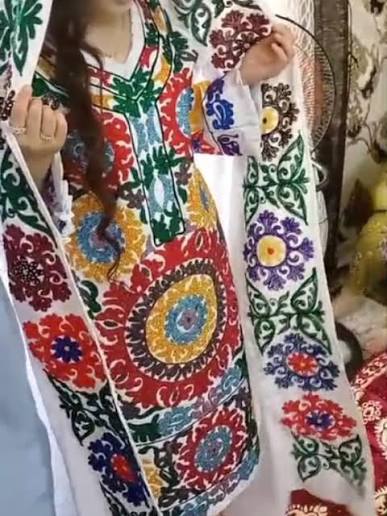
- The art involves embroidering special symbols and patterns onto fabric. In 2018, this ancient art was officially inscribed on the List. The word ‘Chakan’ also refers to a loose women’s dress made from natural fabric and fully decorated with traditional symbolic embroidery.
- The traditional dish Oshi Palav
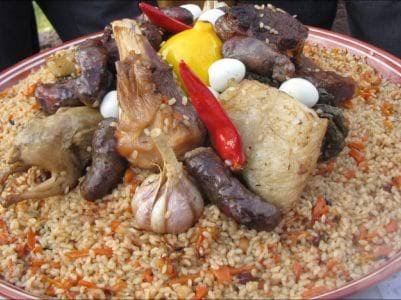
- Oshi Palav is Tajikistan’s principal national dish and a symbol of hospitality, unity and cultural heritage. There is a saying in Tajikistan: ‘If you have not eaten oshi palav, you have not been born into the world.’
- The tradition of preparing sumanak (sumalak)
- A unique, centuries-old ritual of Iranian and Turkic peoples, symbolising the arrival of spring, the renewal of nature, unity and mutual support. This dish is prepared only once a year, during the celebration of Nowruz. Traditionally, sumalak cannot be made alone, as it must be stirred continuously for a whole day. Dozens of people—neighbours, relatives and friends—gather around a large cauldron. The preparation is generally led by the community’s older, most respected women, who pass on their skills to young women.
- The art of making atlas and adras fabrics
- An ancient and unique hand-weaving craft. This pattern-making technique is known around the world as ikat. In 2017, it was included in the Register of Good Safeguarding Practices for Intangible Cultural Heritage.
- The tradition of making the rubab musical instrument
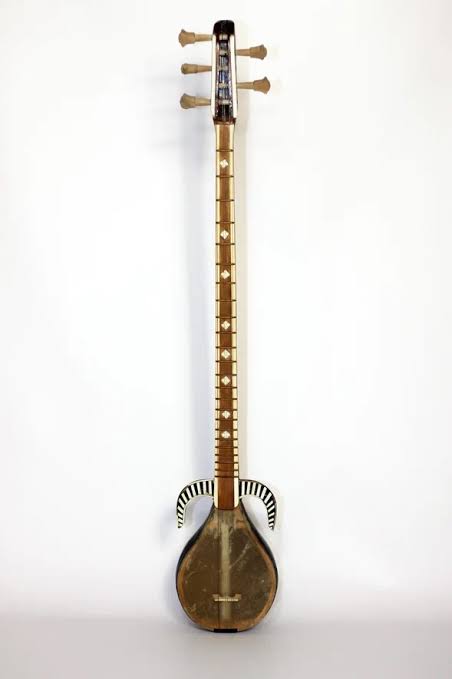
- An ancient and highly respected art that brings together music, profound knowledge of the properties of wood and the jeweller-like precision of the craftspeople (usto). The rubab is one of the most popular bowed and plucked string instruments in Central Asia, particularly in Tajikistan.
- The Sade Festival
- An ancient pre-Islamic Iranian festival symbolising the victory of light over darkness and honouring fire and warmth. Sadeh is one of the most important calendar festivals, with a history spanning thousands of years. It is celebrated every year on 30 August. The name derives from the Persian word for ‘hundred’. It refers to the 50 days and 50 nights remaining from this date until the arrival of Navruz, the Persian New Year. Traditionally, people gather a large quantity of firewood, while Zoroastrian priests dressed in white recite prayers from the Avesta and light a fire.
- The Mehrgan Ceremony
- One of the oldest Persian rituals, dedicated to the autumn harvest, friendship, love and the triumph of good over evil. It is usually celebrated in early October (around 2 October according to the European calendar). It is dedicated to the deity Mithra, who presides over treaties, friendship, the sun and light. The festive table is laid with fruit and grain. People wear purple or violet clothing, gather together, dance and exchange cards and gifts.
- The Art of Illumination: Tazhib/Nakqoshliq
- An ancient decorative art involving the embellishment of manuscript pages, religious texts, calligraphy and miniatures. The name Tazhib derives from the Arabic word ‘zahab’ (gold) and literally means ‘gilding’. It is a specialised technique for covering page edges and elements of text with gold leaf or gold paint. The term ‘Nakqoshliq’, meanwhile, derives from the Arabic word ‘naqsh’, meaning ‘drawing’ or ‘pattern’. This art involves applying intricate floral and geometric designs.
- The tradition of anecdotes about Khoja Nasreddin
- A cycle of popular satirical and humorous stories about a folk sage, philosopher and joker. The first written references and collections appeared in the Ottoman Empire in the sixteenth century, and it was added to the List in 2022.
- The Navruz Festival
The Navruz Festival
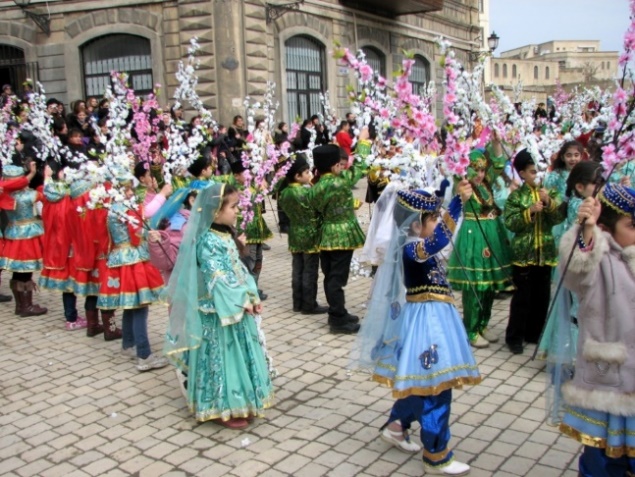
It is worth devoting a separate paragraph to the Navruz festival, as it is of great importance in the history of Tajikistan and holds a special place in its culture. It is celebrated in more than 15 countries, but the Republic of Tajikistan stands out among them for the grandeur, traditional character and official status of its celebrations.
Historically, according to the agricultural calendar, people planted their gardens on this day. It was believed that during the celebration of Navruz Bayram, winter fully receded and the season of warmth and ploughing began. Today, the festival has a similar meaning: this is the day when true spring arrives, ushering in a period of complete renewal, spiritual growth and the blossoming of kindness. Navruz Bayram is none other than the day of the spring equinox. The name ‘New Day’ or ‘New Year’ is now becoming more widespread. According to the astronomical solar calendar, it is celebrated from 21 to 24 March in many cultures across the Middle East and Central Asia, including most people in Tajikistan. In Tajikistan in particular, Navruz has special state status and is regarded as a symbol of national revival. In 2009, UNESCO included Navruz on the Representative List of the Intangible Cultural Heritage of Humanity.
Before the festival, people always carry out a thorough clean of their homes and wash carpets and clothes as a symbol of cleansing away the troubles and negativity of the previous year. They also buy or make new clothes. According to tradition, women and girls wear dresses made from brightly coloured national fabrics—atlas and adras.
The main decoration of the home is the festive tablecloth (dastarkhan), on which symbolic items are displayed: Haft Sin—seven items beginning with the Persian letter ‘Sin’; Haft Shin—seven items beginning with the letter ‘Shin’; and, as essential items, a mirror symbolising purity, candles and an aquarium with a goldfish symbolising life.
The main Navruz dish is Sumanak. It is made from sprouted wheat grains, flour and water. Preparing this dish takes a whole day! Another distinctive feature is that it is made exclusively by women, who usually gather as a whole community around the cauldron. As they cook, they sing traditional songs, dance and make wishes.
 |
 |
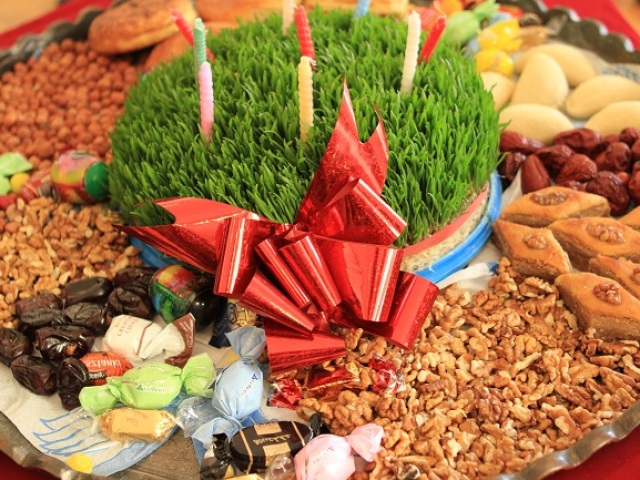 |
The pictures show: 1—Chakan embroidery; 2—the national musical instrument, the rubab; 3 and 4—the Navruz Bayram celebrations; 5—the traditional dish Oshi Palav. Available: https://www.instagram.com/p/DWelTVgjPZS/?img_index=2, https://goodhouse.com.ua/poradi/16346-shho-oznachaye-svyato-navruz-bajram-koli-jogo-vidznachayut-shho-daruyut-yaki-stravi-gotuyut-yaki-narodi-i-kraini-svyatkuyut-navruz-bajram-pozdorovlennya-na-svyato-vesni-navruz-bajram-21-bere.html https://blog.comfy.ua/ua/palov-osh-gotuehmo-najjsmachnishijj-uzbeckijj-plov/
 |
 |
These elements demonstrate the country’s cultural diversity and raise its profile around the world. Festivals such as Navruz, Mehrgan and Sadeh symbolise the continuity of the Persian cultural tradition.
The principal instrument for regulating cultural policy is the Law of the Republic of Tajikistan dated 30 June 2024. According to official information, the aim of the new version is to protect the true values of national culture and to prevent extravagance, superstition and fanaticism. Article 18 of the Law also officially prohibits the import, sale and advertising of, and wearing in public places, clothing that ‘contradicts national culture’. There are, of course, exceptions concerning religious clothing, such as the Muslim hijab.
During traditional festivals such as Navruz, for example, the country has four official days off. The priority of ethnic culture over religious culture is enshrined in the Law of the Republic of Tajikistan ‘On Public Holidays’.
The Ministry of Foreign Affairs of Tajikistan officially uses art as an instrument of ‘soft power’ to enhance the country’s international image. At Dushanbe’s initiative, the UN General Assembly declared Navruz an ‘International Day’. The inclusion of Chakan embroidery, the culture of wearing atlas and adras, and Oshi Palav on UNESCO lists is presented in official state media as evidence of the nation’s greatness and the president’s personal achievements.
The use of the geopolitical concept of a ‘common linguistic and cultural space’ helps to develop special political relations with Iran and Afghanistan through the shared heritage of classical Persian literature (Rudaki, Ferdowsi and Omar Khayyam).
Also, as I have already said, history forms the foundation of every country’s future; without history, there can be no future. The founding of the first Tajik state, the Samanid dynasty, is therefore officially recognised as the foundation of modern statehood. The currency is named the somoni, and the highest order is the Order of Ismoili Somoni, in honour of the Samanids.
Conclusions
In my view, a country’s culture and historical values are the foundation of the state. They should underpin all political decisions and laws. Of course, morality, humanity and justice must come first, but it is culture and tradition that bring an ordinary group of people together into a cohesive national whole. It is entirely right to showcase one’s identity on the international stage. Tajikistan has distinctive and fascinating traditions that make it recognisable around the world and win it support. In my view, what is missing is bringing this culture into the political sphere. It could enable Tajikistan to expand its cooperation and secure trade agreements based on its unparalleled culinary techniques, unique equipment and products. The surge in popularity of falak music in the early twentieth century helped the world see Tajikistan from a different perspective and learn a little more about it than newspapers can convey. I am sure that falak performed on the stage at the headquarters in Paris in 2005 helped secure significant support from diplomats and political figures. Tajikistan has much to offer the world; it simply needs to shift the focus of this culture somewhat from domestic to foreign policy. Traditional youth exchanges to promote wider understanding of the country’s history are entirely feasible, as are international events and educational opportunities for international students. Global music culture is enriched every day by new composers, genres and subgenres. In my view, contemporary music is becoming grey and monotonous, while historical musical culture is beginning to be forgotten and relegated to the background. This is something we must not allow to happen. Music should be brought to the fore and showcased to the world through concerts, masterclasses in playing traditional instruments, and the promotion of traditional instrument-making techniques. To conclude, having examined Tajikistan’s history in such detail, we can say that it has fully shaped the state as it exists today and laid the foundations for its governance, international relations and cooperation between countries.
Sources
https://spadok.org.ua/skify/stvorennya-perskoyi-derzhavy
https://osvita.ua/vnz/reports/world_history/32900/
https://uk.wikipedia.org/wiki/%D0%A8%D0%B0%D1%88-%D0%BC%D0%B0%D0%BA%D0%B0%D0%BC
https://kmt.tj/ru/russkij-falak-nacioinalnoe-muzyk/ (falak music)
https://ich.unesco.org/en/state/tajikistan-TJ?info=elements-on-the-lists (UNESCO list)


